Mission
The GFMC, hosted by the Fire Ecology Research Group, a subdivision of the Biogeochemistry Department of the Max Planck Institute for Chemistry at Freiburg University, and Associated Institute of United Nations University (UNU), provides a publicly accessible global portal for landscape fire documentation, information and monitoring. Its contents are generated by a worldwide network of cooperating institutions, dealing with early warning, archiving and interpretation of fire information, support to develop public policies and implementation strategies and decisions from local to international level.
Reduce the negative impacts of landscape fires on the environment and humanity
The GFMC through the Global Wildland Fire Network and the UNDRR Wildland Fire Advisory Group has established an interagency and inter-sectoral forum on Landscape Fires of UN and non-UN agencies and programmes to facilitate the creation of mechanisms of information and task sharing to (a) prevent and reduce the negative impacts of landscape fires on the environment and humanity, and (b) to advance the knowledge and application of the ecologically and environmentally benign role of natural fire in fire-dependent ecosystems, and sustainable application of fire in land-use systems.
The own network is the Global Wildland Fire Network (GWFN). The UNECE/FAO Team of Specialists on Forest Fire expanded gradually its regional work towards building the Global Wildland Fire Network. After the phasing out of the UNECE/FAO Team in 2015, the Eurasia Team of Specialists on Landscape Fire Management was created as follow-up under the auspices of the Council of Europe's Major Hazard Agreement (EUR-OPA) in 2018. The Team is performing its work in close cooperation with the Organization for Security and Cooperation in Europe (OSCE).
Each of the 14 Regional Wildland Fire Networks has one or more regional coordinators and co-coordinators, as well as national focal points. These are found on the websites of the Regional Wildland Fire Networks.
GFMC:
http://gfmc.online/
GWFN:
http://gfmc.online/globalnetworks/globalnet.html
GFMC within EUR-OPA Agreement:
https://europa-projects.ext.coe.int/en/centre/18-global-fire-monitoring-center.html
International Wildfire Preparedness Mechanism (IWPM):
http://gfmc.online/iwpm/index-7.html
Former ISDR-IATF Web Page of the Working Group 4 "Wildland Fire":
https://www.unisdr.org/2005/task-force/tf-working-groups4-eng.htm
(1) GFMC and GWFN are supporting countries to develop national landscape fire management policies and implementation strategies.
(2) Emphasis is given to enhance participation and responsibility of local communities in fire management through participatory approaches ("Community-Based Fire Management")
GFMC is running the first global prototype of a "Global Wildland Fire Early Warning System":
http://gfmc.online/gwfews/index-12.html
This includes a global portal for regional and national wildland fire early warning systems:
http://gfmc.online/fwf/fwf.html
GFMC is offering assistance to countries to enhance fire management capacity through competency-based training. National Round Table on Fire Management, which are mainly targeted to develop national fire management policies, go along with participation of civil society.
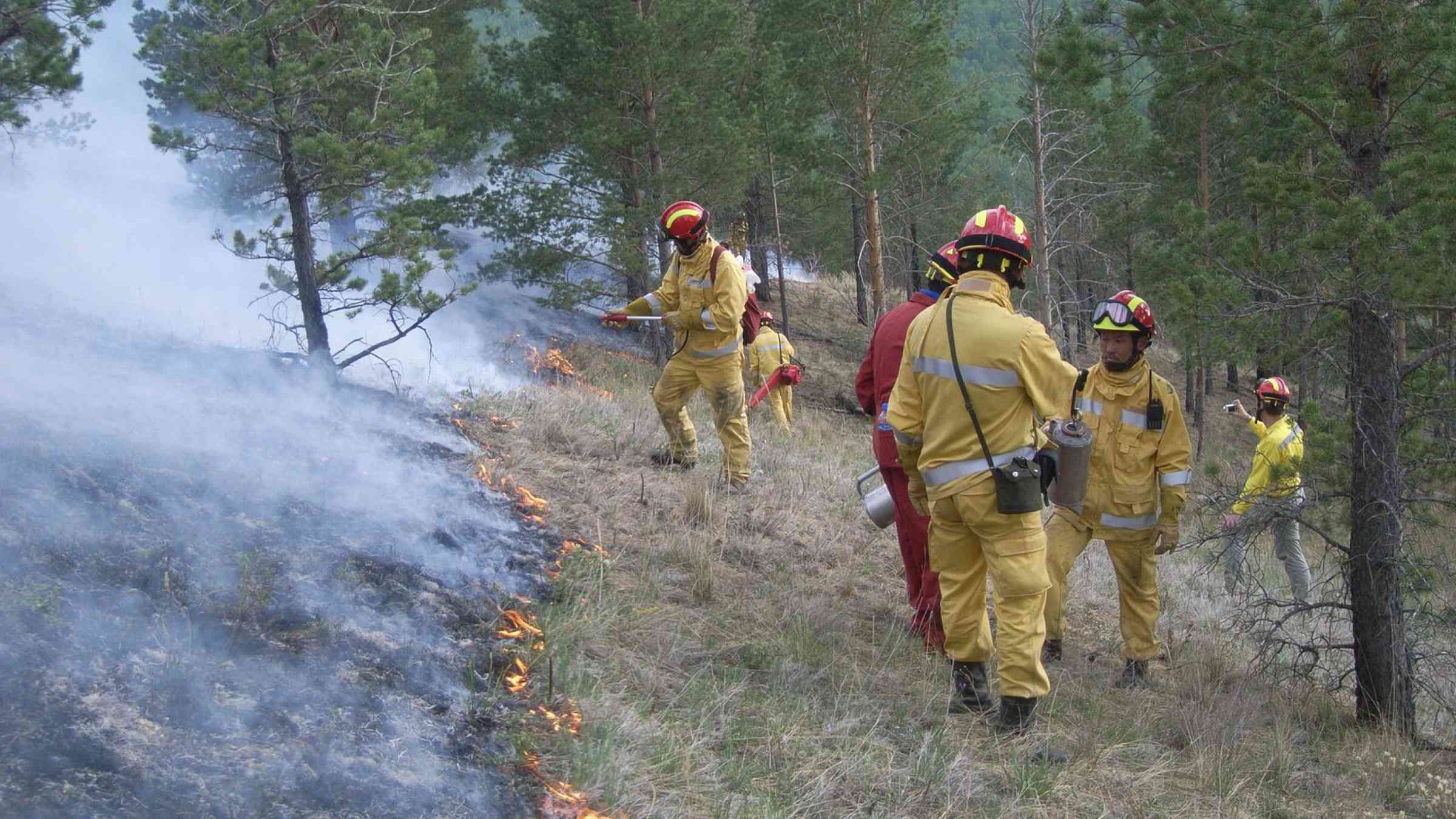
Since the vast majority of vegetation fires, including uncontrolled wildfires, are caused or set by humans, either as a consequence of negligence, unawareness of risks, often in the frame of rural land use and land-use change, the main approach on community-based fire management is to reduce unwanted fires. The outreach work includes however capacity building in ecologically benign and safe burning practices (prescribed burning) where applicable.
Preparedness activities in fire management go closely along with the prevention of underlying risk factors. Emphasis is given to empower local communities in taking effective and efficient responsibilities in wildfire preparedness. Local to national land management authorities and fire services are also supported. At international level GFMC is serving as Secretariat of the (1) International Fire Aviation Working Group (IFAWG), and (2) the International Wildfire Preparedness Mechanism (IWPM), both of which are developing SOPs / voluntary guidlines for international wildfire preparedness and response.
Global wildland fire information and data repository
GFMC through the Regional Wildland Fire Networks is supporting national and local governments to protect the urban (and rural) populations against fires affecting the interface between natural & cultural landscapes and residential / peri-urban interfaces, and against the adverse effects of vegetation fire smoke pollution.
No results found.
Voluntary Commitments
The Sendai Framework Commitments (SFVC) online platform serves to incentivize stakeholders to inform the public about their work, to provide a vehicle for sharing commitments and initiatives and for motivation toward the implementation of the Sendai Framework. In turn, UNDRR can monitor and take stock of the progress and impact.
Global Fire Monitoring Centre is involved in the following commitments: