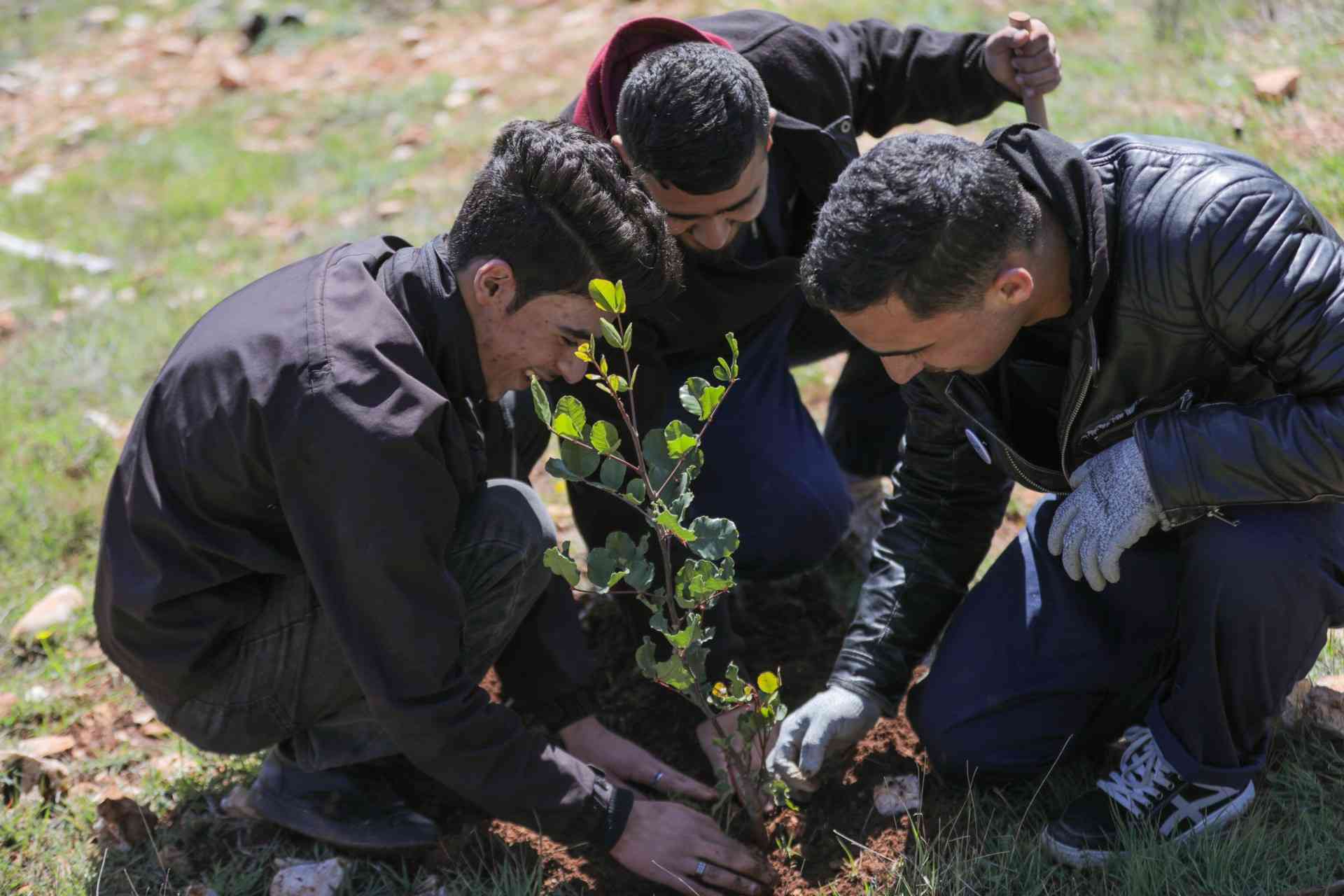
Youth-Led Climate Action for Resilient Communities: “SAWN” (Preservation) Project
Generations For Peace, with UNICEF and national partners, empowers youth across Jordan through SAWN to lead climate action and resilience efforts. Since 2022, youth have mobilised thousands of volunteers and initiatives; in 2026–2027 SAWN will scale leadership, community impact, and national climate advocacy.
Description
Generations For Peace (GFP) is a Jordan-based organisation dedicated to advancing youth-led peacebuilding, social cohesion, and community resilience. Our mission is to empower young people through locally driven, inclusive programming that strengthens their ability to address evolving community challenges—including climate and environmental risks. The SAWN Programme (“Preservation” in Arabic) directly supports the Sendai Framework by enhancing risk understanding, investing in local youth capacities, and expanding inclusive participation in climate governance and disaster risk reduction.
Since its launch in 2022, SAWN has enabled more than 258 youth leaders to implement around 108 environmental initiatives that mobilised over 7,500 volunteers across Jordan. Youth have participated in global climate platforms including COP and led Jordan’s LCOY for four consecutive years. Building on this momentum, the 2026–2027 phase consolidates SAWN as a national youth leadership model grounded in competency-based training, accountable implementation, and measurable environmental and social impact.
The objective is to strengthen Jordan’s climate resilience by equipping adolescents and youth with the skills, resources, and platforms needed to design and implement local solutions and to influence climate policy at sub-national and national levels.
It aims at achieving cumulative environmental outcomes by end-2026 of approximately 21,700 trees planted, 21,700 kg of solid waste collected, and 75,950 litres of water saved.
Deliverables: SAWN will deliver structured training curricula and facilitator-led peer workshops; youth-led initiatives across all 12 governorates; policy and advocacy briefs; and comprehensive monitoring, evaluation, and learning (MEL) reports. Knowledge products—including toolkits, multimedia content, and practice guides—will support sustainability and replication nationally and regionally.
Conclusion: Through SAWN, GFP deepens Jordan’s climate resilience by combining practical community action with meaningful youth participation in climate governance. The programme strengthens environmental stewardship, social cohesion, and preparedness for climate-related hazards—ensuring long-term, scalable impact aligned with the Sendai Framework.
Did the Sendai Framework change or contribute to changes in your activities/organization? If so, how?
The Sendai Framework has guided GFP to integrate risk reduction, resilience thinking, and inclusive participation throughout SAWN. It has reinforced the importance of analysing local risks, investing in community-level action, and ensuring meaningful youth engagement in climate governance. SAWN’s design—rooted in youth-led analysis, community initiatives, and structured policy engagement—reflects Sendai priorities on understanding risk, strengthening preparedness, and investing in resilience.
What led you to make this commitment/initiative?
What was your position before making this Voluntary Commitment / prior to the Sendai Framework?
SAWN was inspired by the urgency of climate challenges in Jordan—water scarcity, rising temperatures, pollution, and environmental degradation—which disproportionately affect vulnerable communities. GFP recognised that adolescents and youth are key agents of change who can design solutions and influence policy when equipped with knowledge, skills, and leadership opportunities. The programme is grounded in the premise that environmental stewardship, resilience, and social cohesion are mutually reinforcing.
Deliverables and Progress report
Deliverables
Deliverables are the end-products of the initiative/commitment, which can include issuance of publications or knowledge products, outcomes of workshops, training programs, videos, links, photographs, etc.
Through SAWN, 350 youth climate leaders across Jordan receive structured training in climate science, leadership, advocacy, volunteer mobilisation, and practical project implementation. Training is delivered via intensive four-day cycles (14 cohorts × 25 youth), reinforced through mentoring and coaching to enable cascading peer learning and local action.
Output will be: Training curricula; facilitator guides; attendance lists; pre/post assessments; photos/videos. Documentation will include photos, attendance, and verification of indicators.
Youth leaders co-design and implement at least 50–72 community-level initiatives across all 12 governorates, addressing water conservation, solid waste management, tree planting, and environmental education. Each initiative includes needs assessment, action planning, implementation, and monitoring, registered and tracked on the Nahno Platform.
Output will be: Initiative proposals and reports; case studies; media assets; Nahno registration and verification records. Documentation will include photos, attendance, and verification of indicators.
Youth engage in national climate governance through policy briefs, structured youth–policy dialogues, and contributions to the Youth and Children Climate Declaration submitted to the Ministry of Environment. Activities build youth capacity to articulate community priorities and propose actionable policy solutions.
Output will be: Policy briefs; meeting summaries; official submissions/endorsements; participation records from dialogues.
A comprehensive MEL framework includes baseline, midline, and endline tools to track knowledge, leadership skills, civic engagement, and behaviour change among youth leaders and participating volunteers. Data capture includes disaggregation (age, gender, disability, location) and environmental indicators (trees planted, waste collected, water saved).
Outputs: MEL plan; baseline/midline/endline surveys; monitoring dashboards; final evaluation report.
Accessible toolkits, training guides, and multimedia content are produced to share methodologies, lessons learned, and good practices, enabling replication and scaling within Jordan and other climate-vulnerable contexts. Materials reinforce inclusive participation and practical community action.
Output will be: Toolkits; training packs; short videos; infographics; dissemination workshops/webinars.
Organizations and focal points
Implementing Organization(s)
Focal points
If a VC's contact information has been hidden, the SFVC team can forward a message.Partners