School Club Based Resilience Community Model Project (SCBMRP), Nepal – Third Phase
The project aims to propagate disaster education from DRR education clubs of schools to its respective communities through interactive games and tools designed both for children and adults learn about risks and its countermeasures effectively.
Description
The School Club Based Resilient Community Model Project (SCBRCMP) is a joint project implemented by Plus Arts NPO, CityNet, and the Informal Sector Service Center of Nepal. Funded by the Japan International Cooperation Agency (JICA), the project was started as a response to the April 2015 earthquake which stressed the need for disaster awareness and education in the country. The first two phases of the project were specifically co-implemented by CityNet Yokohama Project Office from 2017 – 2020 with significant outcomes involving 18 schools across five target municipalities.
This voluntary commitment accounts for the third phase of the project co-implemented by CityNet Kobe Office, which aims to expand the scope of disaster risk education to at least 50 schools across Kathmandu Valley building on the first two phases of the SCBRMCP. The first year of the third phase project utilizes the previously established DRR Education Clubs to disseminate knowledge and strategies of addressing risks through interactive games and tools. The project has been capacitating teachers of Kathmandu Valley to develop effective educational tools to help children understand disaster risks more effectively, thereby knowing the ways to address the risks at household levels. The first year of the third phase included tool development workshops for teachers on safe construction practices as well as addressing infectious diseases including Dengue and COVID-19
Did the Sendai Framework change or contribute to changes in your activities/organization? If so, how?
The project primarily focuses on understanding disaster risks by each and every household in the community. The knowledge transfer process is from schools to the communities. The first priority of the Sendai Framework directly relates to this activity.
What led you to make this commitment/initiative?
What was your position before making this Voluntary Commitment / prior to the Sendai Framework?
While the risks and its countermeasures are being understood by the technical people, the public in general still lacks proper and effective ways of addressing risks. Therefore, to counter such gap in knowledge dissemination, the project targets the grassroots population and utilizes the DRR Education Clubs in schools. We have continuously worked at the grassroots and the local government level prior to the Sendai Framework as well.
Deliverables and Progress report
Deliverables
Deliverables are the end-products of the initiative/commitment, which can include issuance of publications or knowledge products, outcomes of workshops, training programs, videos, links, photographs, etc.
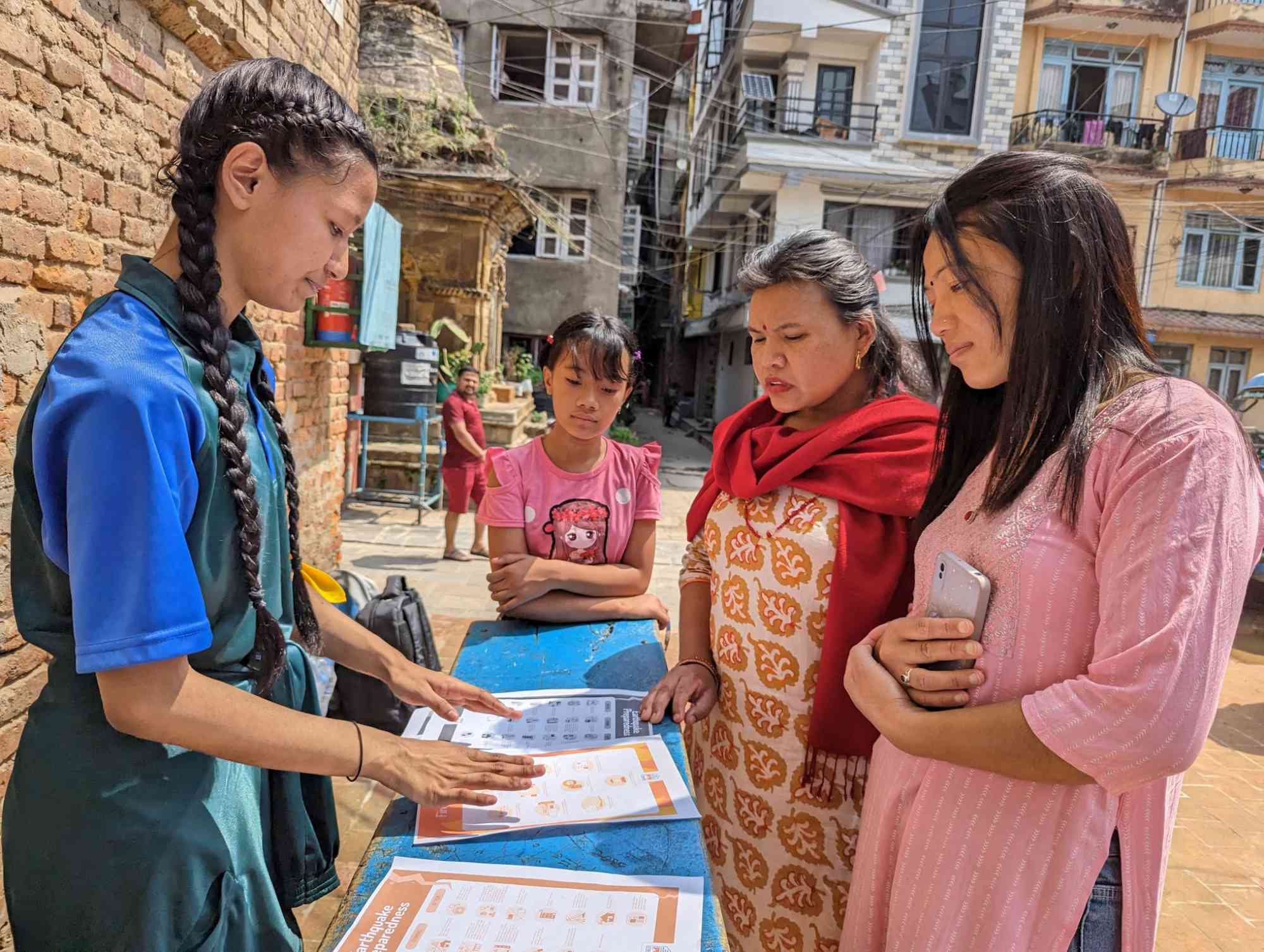
As a first pilot case, the DRR Club members of Bhassara Secondary School of Lalitpur Metropolitan City organized a community DRR event where the students engaged the public to understand DRR through games. The event was organized by the school in collaboration with the local community. The event was free and allowed both children and adults to learn about disaster prevention through activities.
Separate workshops on safe construction methods particularly for Nepal and understanding infectious diseases correctly have been conducted to help teachers develop effective educational tools to be used in schools and communities. Local experts on construction from the National Society for Earthquake Technologies (NSET) and infectious diseases experts from Lalitpur Metropolitan City provided the necessary content to enable the learning process to become more effective.
The prototype tools designed by the teachers have then been converted to proper tools for schools and communities to use to disseminate knowledge on the two topics.
Organizations and focal points
Implementing Organization(s)
Focal points
Partners