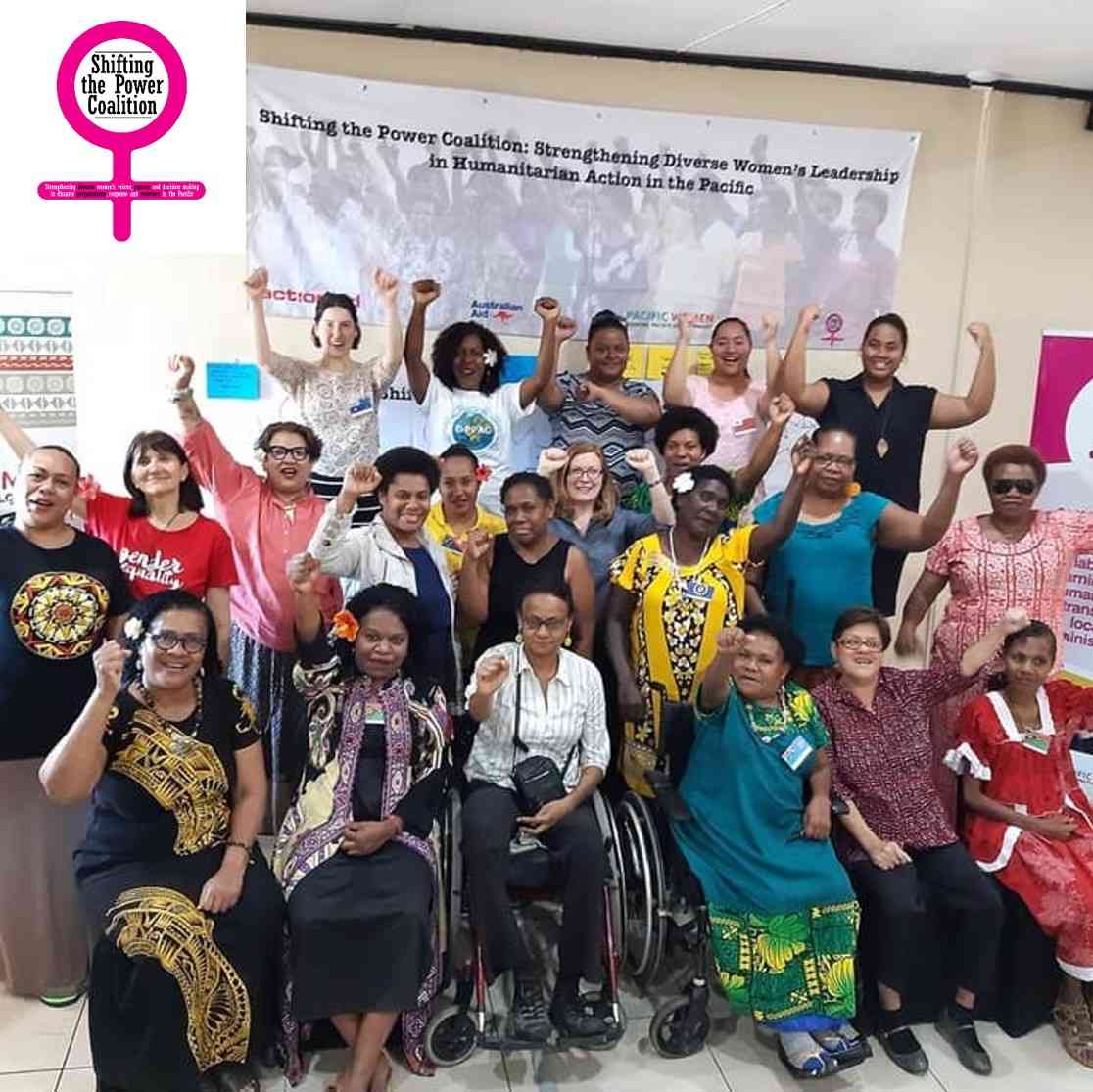
Demonstrating the Power and Potential of Women Leadership in DRR
Shifting the Power Coalition is comprised of women’s rights and disability organisations across the Pacific region working together to strengthen diverse women’s voices, agency and decision making in disaster preparedness, response and recovery.
Description
Humanitarian responses have traditionally been controlled by male-dominated international bodies, leaving little space for women in affected communities to lead. As a result, women’s rights and needs are rarely prioritised in their response. The Pacific is experiencing a significant increase in climate-induced humanitarian disasters. In this context, ActionAid Australia is working as part of the ‘Shifting the Power Coalition’ to support women to lead emergency response and take power back into their own hands – ensuring disaster response addresses women’s needs. Shifting the Power Coalition is working to build the existing power and knowledge of women emergency responders.
On the frontlines of disaster, women play a vital role in all stages of disaster management. Their leadership is critical to the localization of the Sendai Framework and the call from women at the conference to strengthen women's leadership in DRR policy and decision making at all levels. This catalyzed the founding members of the Shifting the Power Coalition to come together and identify wats to make this happen in the Pacific.
Since 2016, we are working together, across 7 countries and 13 organisations with the Pacific Disability Forum and national partners (please see section on organisations and focal points).
Today, spanning a network of close to 100,000 grassroots, intergenerational and inclusive movements, we are the only women-led regional alliance focused on strengthening the collective power, influence and leadership of diverse Pacific women to respond to disasters and climate change. Bringing attention to women’s collective peacebuilding, community-led activism, Pacific-driven innovation and humanitarian expertise, the Coalition has brought attention to women’s collective and personal lived realities – mobilizing rapid response support to women during the Samoa measles epidemic, supporting COVID19, supporting local women including women with disabilities to lead disaster response and recovery.
The Coalition enables resources – including the time and space to meet – to reach women when they need it, to deliberate, participate, design and deliver what works for diverse women and in local communities.
Did the Sendai Framework change or contribute to changes in your activities/organization? If so, how?
The Sendai Framework for Disaster Risk Reduction is the global roadmap to reduce disaster risk by 2030. It stated that gender, disability and other perspectives should be integrated in all processes of DRM.
Women and their participation are critical to effectively design, resource and implement gender-sensitive DRR policies, plans and programmes. Furthermore, it calls for capacity building to empower women for preparedness as well as to secure alternate means of livelihood in post-disaster situations.
Our work is not only well aligned with the Sendai Framework but is also closely connected to national and regional commitments to progressing women’s rights, gender equality and disability inclusion.
What led you to make this commitment/initiative?
What was your position before making this Voluntary Commitment / prior to the Sendai Framework?
The Pacific is experiencing multiple challenges – from intensifying cyclones, droughts and floods as a result of the climate crisis to recent health pandemics including the long-term impact of COVID19.
In crisis situations, collaboration is also vital. This is one of the reasons why the Shifting the Power Coalition was established and since 2016 we have been working together to bring about change so that disaster management and humanitarian action do not regard women as vulnerable beneficiaries but rather builds on our indigenous and localised knowledge, collective power, influence and leadership
Ensuring sustainable responses requires a new way of driving inclusion in line with commitments from Pacific Leaders, such as the Pacific Leaders Gender Equality Declaration, the Revised Pacific Platform for Action for Gender Equality and Women’s Rights, the Boe Declaration and the Framework for Resilient Development in the Pacific.
We are the only women-led regional alliance strengthening the collective power, influence and leadership of diverse Pacific women in responding to disasters and climate change.
Deliverables and Progress report
Deliverables
Deliverables are the end-products of the initiative/commitment, which can include issuance of publications or knowledge products, outcomes of workshops, training programs, videos, links, photographs, etc.
Hear the voices of Pacific womanitarians.
Strengthening diverse women’s voices, agency and decision making in disaster preparedness, response and recovery in the Pacific.
In this brief, we share solutions for mobilizing women's leadership towards solutions in regards to protection and recovery in a time of COVID-19 and TC Harold.
Read the 2020 Shifting the Power Coalition brochure.
Read the project summary.
The Shifting the Power Coalition Handbook, produced with the support of the Feminist Humanitarian Network, presents lessons learnt from the Samoa response to the 2019 measles pandemic and how the STP Coalition has played a role in documenting the gendered impacts of the health emergency and gaps in the response.
The handbook also draws from experiences of partners in Fiji, Tonga and Vanuatu responding to Tropical Cyclone Harold which brought additional challenges to COVID-19 prevention and response efforts. Many of these recommendations were featured in the Coalition’s advocacy brief.
The handbook is a tool to guide engagement with the ongoing COVID-19 response and prevention of future disasters with specific sections dedicated to women with disabilities as well as young women.
In collaboration with the Generation Equality Forum Civil Society Advisory Group, with the support of the NGO-CSW Committee, Shifting the Power Coalition partners convened “On the Mat” consultations to connect local and national priorities with global commitments to support diverse women’s leadership on Peace and Security.
Through our partnerships with the Feminist Humanitarian Network and the Global Partnership for the Prevention of Armed Conflict we will continue to amplify local strategies to reinforce the power and voice of feminist movements and young women in the implementation of the WPS and Humanitarian Action Compact.
During the event, we launched a new video which is a call to action from young women from Fiji, Papua New Guinea, Samoa, Tonga and Vanuatu who are working together on a regional and national actions in the DFAT supported Australia-Pacific Climate Partnership
Organizations and focal points
Implementing Organization(s)
Focal points
If a VC's contact information has been hidden, the SFVC team can forward a message.Partners